AI Coaching
Human-in-the-Loop AI Coaching: What the Coach Should Still Review
AI can personalize coaching delivery, but some moments still need human judgement. A practical guide to what should be automated, reviewed, or kept fully human.
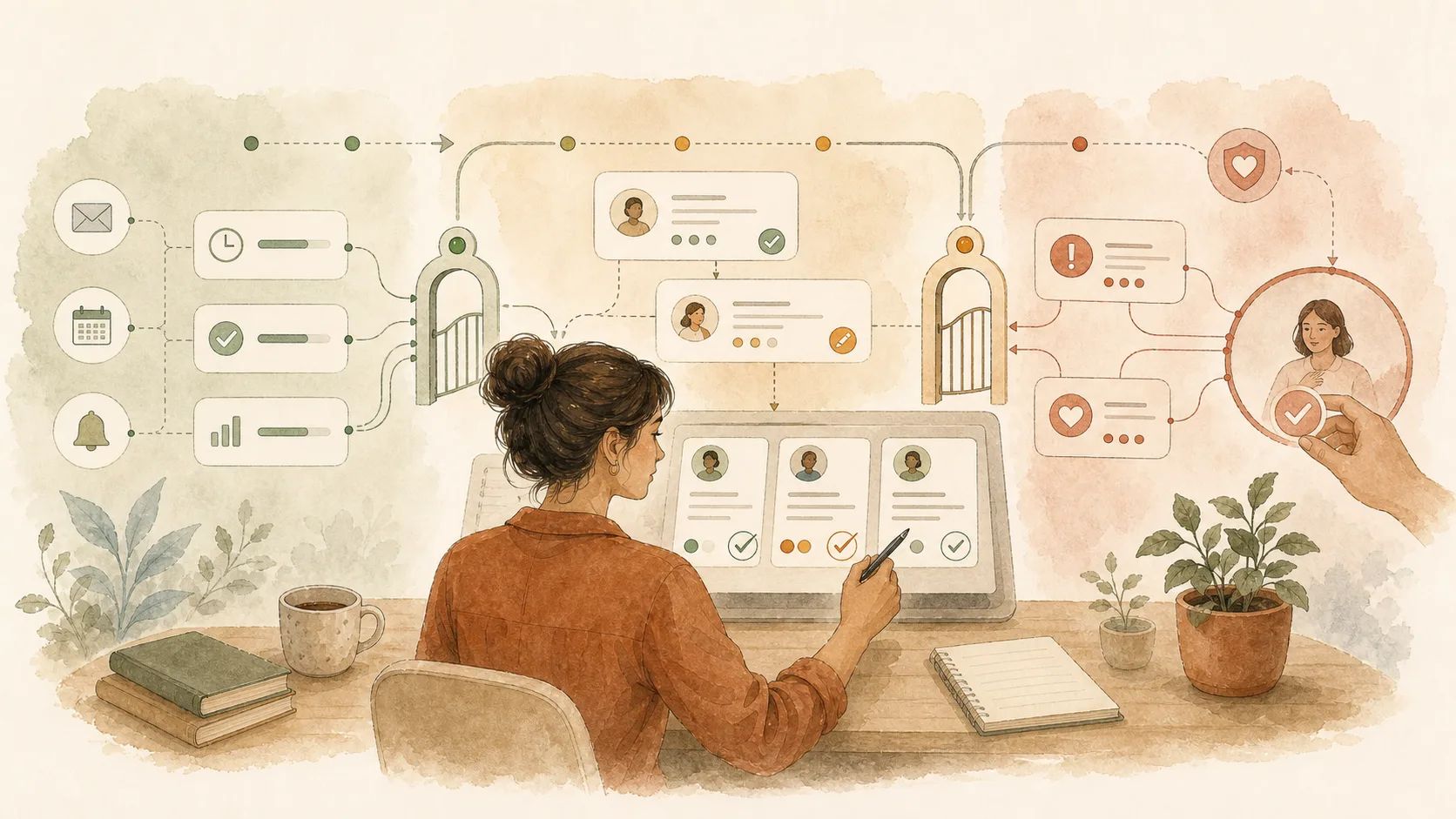
The weakest version of AI coaching is simple:
Let the AI answer everything.
It is tempting because it looks scalable. No calls. No review. No delivery bottleneck. The client asks, the system replies, the business grows.
But coaching is not only answering.
Coaching includes judgement, timing, boundaries, ethics, tone, and responsibility.
That is why the better model is human-in-the-loop AI coaching.
AI handles the repetitive preparation and delivery work. The human stays involved where judgement matters.
The question is not human or AI
Most debates about AI coaching are too binary.
Either AI replaces the coach, or AI is dismissed as shallow.
The practical answer is in the middle.
Some tasks are perfect for AI:
- Summarizing a client check-in.
- Matching a client answer to a program step.
- Drafting a personalized message.
- Turning a framework into a client-specific exercise.
- Creating a first version of an audio script.
- Detecting missing information.
- Flagging answers that may need review.
Other tasks still need a human:
- Deciding whether the intervention is appropriate.
- Handling sensitive personal situations.
- Changing the method.
- Making ethical calls.
- Giving feedback where nuance matters.
- Taking responsibility for the client experience.
The goal is not to remove the coach.
The goal is to stop wasting the coach on repetitive delivery.
Review the first version of anything important
When creating an async coaching system, start with more human review than you think you will need.
Review the first personalized sessions. Review the first client summaries. Review the first accountability messages. Review the first edge cases.
This is not only about safety.
It is how the system learns the method.
You will notice patterns:
- The AI is too soft.
- The AI is too generic.
- The AI gives too many options.
- The AI misses a key principle.
- The AI sounds unlike the coach.
- The AI assumes progress where there is avoidance.
Each review improves the instructions, examples, and boundaries.
Over time, you can decide what no longer needs review.
Separate low-risk and high-risk moments
Not every interaction has the same risk.
A reminder that says, “Would you like to complete your check-in today?” is low-risk.
A personalized response to a client in distress is high-risk.
A good AI coaching platform should treat these differently.
Low-risk tasks can often be automated once the tone is right.
Medium-risk tasks can be sampled or reviewed in batches.
High-risk tasks should pause for human judgement.
This protects the client and the business.
It also prevents the coach from reviewing everything forever.
A practical review map
Here is a simple way to decide what the coach should review.
Automate:
- Basic reminders.
- Progress nudges.
- Summaries for internal use.
- Routing to the next standard lesson.
- Formatting existing content into a preferred style.
Review before sending:
- Personalized exercises.
- Feedback on client submissions.
- New interpretations of the client’s situation.
- Sensitive tone decisions.
- Messages to clients who are stuck, frustrated, or inactive.
Keep human:
- Clinical, legal, financial, or medical judgement.
- Crisis situations.
- Client complaints.
- Major changes to the coaching path.
- Anything outside the promise of the offer.
This map can change as the system matures.
But it should exist from the beginning.
The coach’s voice is a quality boundary
Voice is not decoration.
In coaching, voice carries trust.
Clients came because they trust a person, a method, or a brand. If the system suddenly sounds like generic productivity software, the experience weakens.
Human review should protect:
- The level of directness.
- The amount of warmth.
- The kind of challenge.
- The words the coach would never use.
- The boundaries the coach always keeps.
- The rhythm of the method.
This matters especially when turning a course into an async coaching offer for course creators.
The buyer is not paying for any answer. They are paying for this method, in this voice.
AI should prepare, not pretend
The healthiest framing is simple:
AI prepares.
The human decides.
In mature systems, the human may not review every output. But the architecture should still make the source of authority clear.
The AI is not the coach.
It is the delivery layer for a human method.
That distinction shapes the product:
- The system asks for the right client input.
- The method defines what a good answer looks like.
- The AI drafts or adapts the next step.
- The workflow decides what needs review.
- The client receives something coherent and personal.
This is how async coaching scales without more Zoom calls while keeping the work grounded.
What to measure
Human-in-the-loop does not mean slow.
It should make the human more effective.
Track:
- How many outputs need review.
- How many reviewed outputs require edits.
- What kinds of edits happen repeatedly.
- Which client situations trigger human review.
- How long it takes from check-in to delivery.
- Whether clients complete the next step.
If the coach edits everything, the system is not ready.
If the coach edits nothing and never audits quality, the system may drift.
The useful middle is a workflow where human attention goes to the moments that actually need it.
Trust is the product
AI can make coaching more personal at scale.
But trust is still the product.
Clients need to feel that the guidance is connected to a real method, held by a real person, and bounded by real judgement.
That does not require live calls for every step.
It does require thoughtful design.
Human-in-the-loop AI coaching is not a compromise.
It is the model that lets personalization scale without pretending judgement can be fully automated.
🤖 AI-assisted article draft prepared for asyncoaching.com.